Solutions
Water Damage Claims
We turn mitigation documentation, moisture readings, rebuild scopes, and carrier correspondence into organized claim support built for restoration contractors.
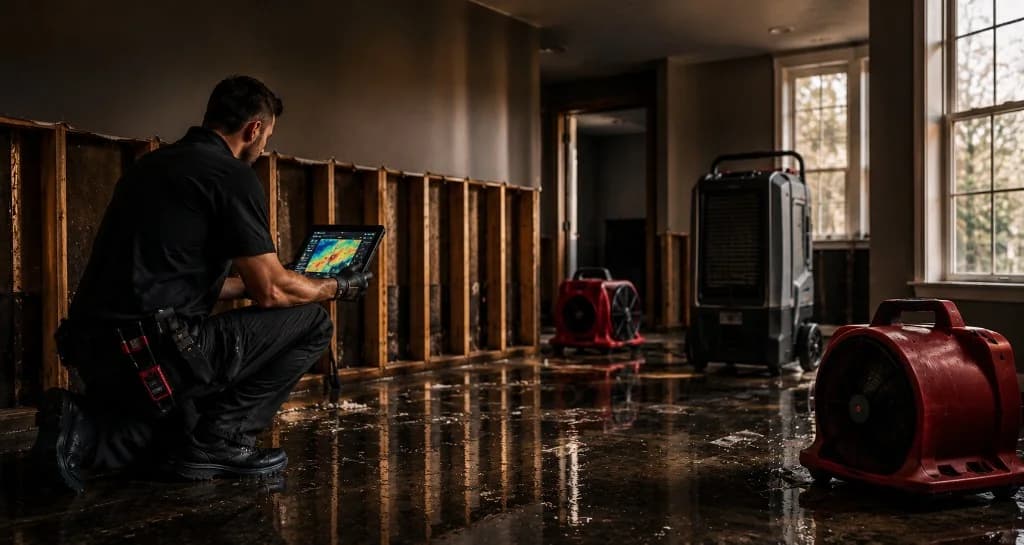
Water claim support
Built for mitigation, rebuilds, and documentation-heavy losses
Water losses move quickly and carriers scrutinize every detail. Claims Ninja helps restoration contractors organize the file, connect mitigation to reconstruction, and identify supplement opportunities.
Emergency Mitigation
Documentation support for dry-out, equipment, moisture mapping, demolition, containment, and carrier review.
Reconstruction Scopes
Scope development for drywall, flooring, cabinets, trim, paint, contents handling, and affected assemblies.
Complex Water Losses
Support for category/class considerations, multi-room damage, hidden moisture, access issues, and documentation-heavy claims.
How it works
From mitigation file to claim strategy
- 01
Submit Claim Materials
Upload photos, moisture readings, estimates, drying logs, equipment records, carrier correspondence, and rebuild details.
- 02
We Organize the Loss Picture
Our team reviews affected areas, drying documentation, demolition scope, rebuild requirements, and estimate gaps.
- 03
Supplement Opportunities Are Identified
We flag missing line items, pricing issues, scope gaps, and documentation needs that may warrant carrier review.
- 04
Contractor Gets a Clear Path Forward
You receive organized next steps, documentation direction, and claim support without building an internal claims department.
What we handle
Water damage claim details carriers love to question
Moisture Documentation
Moisture readings, dry logs, affected materials, equipment usage, and drying timelines should support the scope being presented.
Mitigation Scope
Water extraction, containment, demolition, antimicrobial treatment, equipment, monitoring, and labor details may require careful review.
Rebuild Scope Alignment
Drywall, insulation, flooring, trim, paint, cabinetry, and affected assemblies should connect cleanly to the mitigation file.
Category & Class Considerations
Category of water, class of loss, affected areas, and material porosity can shape documentation and estimate review.
Contents & Protection
Pack-out, manipulation, protection, cleaning, storage, and reset considerations may affect the claim depending on scope.
Carrier Documentation
Photos, notes, logs, invoices, estimates, and correspondence should tell one consistent story before submission.
Common water damage items that deserve a second look
Not every item is owed on every claim. These are common areas that may require review depending on documentation, policy, scope, and loss conditions.
- Moisture mapping and dry logs
- Equipment days and monitoring
- Content manipulation or pack-out
- Baseboard, trim, and paint transitions
- Drywall cuts and insulation
- Cabinet detach/reset or replacement
- Flooring removal and matching concerns
- Containment and dust protection
- Antimicrobial treatment
- Demo labor and debris handling
- Access, masking, and protection
- Rebuild scope alignment after mitigation
Frequently Asked Questions
Answers to common questions about water damage claims.
We review mitigation invoices, drying logs, moisture readings, and rebuild scopes for completeness. Common gaps include equipment days, containment, antimicrobial treatment, demolition, and rebuild line items carriers trim on first pass.
Daily moisture logs, equipment placement photos, atmospheric readings, and clear drying goals carry weight in review. Gaps in documentation often lead to reduced equipment days or disputed mitigation charges.
Yes. Our contractor resources library covers water mitigation supplements, dry logs, moisture mapping, equipment charges, monitoring visits, and denial recovery — written for field and supplement teams.
Yes. We ensure field notes, photos, and line items align with how the loss was classified. Misalignment between mitigation narrative and billed scope is a common reason carriers reduce payment.
Absolutely. Many water claims span emergency services and rebuild. We track both phases, compare carrier scopes to field conditions, and pursue missing items across mitigation and construction line items.
We separate mitigation documentation from rebuild estimating so carriers can follow the timeline. Clear phase separation reduces confusion when adjusters review equipment charges alongside finished reconstruction scope.
Yes. Commercial water claims often involve larger drying footprints, business interruption considerations, and multi-trade rebuild scopes. Documentation organization becomes critical at that scale.
Commercial water claims require zone-level documentation scaled to property footprint: intake and documentation plan, moisture maps per chamber, asset-tagged equipment records, daily dry logs, tenant impact logs on occupied properties, containment and HEPA proof, and indexed closeout packets. Treat retail, office, and multifamily losses with separate indexing per suite or unit — not residential single-file patterns.
Document each affected unit with unit number, floor, and stack position on photos, moisture maps, and dry logs. Separate in-unit scope from common areas. Maintain tenant access and impact logs aligned to monitoring visits. Capture baseline readings per unit before equipment set and terminal readings at closeout — unit-level evidence prevents proportional reductions when carriers cannot verify scope per billed unit.
Treat each affected unit as a separate drying chamber with consistent naming through maps, logs, and photos. Document vertical migration at stack boundaries and common-area scope separately from units. Coordinate access with property management and log every entry event. Phased supplements with dated map revisions when scope expands across floors or units — merged multifamily files fail desk review when unit evidence is undifferentiated.
Higher invoice totals trigger specialist desk review and third-party audit. Carriers reconcile equipment utilization, monitoring visits, and multi-chamber drying scope against asset-tag photos and daily logs — not estimate macros. Tenant coordination, business interruption overlap, and phased supplements add review layers residential files rarely face. Weak zone-level evidence invites proportional reductions across the entire commercial file.
An indexed commercial closeout packet: documentation plan, intake records, zone-level moisture maps, chronological dry logs per chamber, asset-tagged equipment proof, containment and HEPA records, tenant impact log, contents notes where applicable, terminal readings, and equipment pull documentation. Cross-reference each billed line to dated evidence by zone — not a single residential-style photo dump.
Maintain a tenant impact log from mobilization: relocation or habitability notices, access restrictions, property management coordination, contents disruption, and communication timestamps. Photograph tenant-affected areas with unit identifiers and document authorization for access. Align log entries to unit-level mitigation records — production in occupied buildings must match access and coordination documentation at desk review.
Mitigation contractors document contemporaneous operational impact: areas closed to business, production downtime, after-hours requirements, and phased zone release with dated photos and access logs. This supports insured BI narratives but does not replace coverage analysis between insured and carrier. Separate mitigation evidence from insured financial records — strong field documentation helps align drying timelines with business continuity without conflating claim types.
Common drivers: residential file structure on multi-zone footprints, equipment billed without asset-tag placement proof, monitoring gaps between chambers, multifamily units merged into single logs, missing tenant access records, and unsorted closeout packages without indexed line-item cross-reference. Carriers apply proportional reductions when any zone lacks contemporaneous evidence — organized zone-level documentation strengthens recovery and supplement arguments.
Category 3 water is grossly contaminated per IICRC definitions — common sources include sewage backup, toilet overflow, river or exterior flood intrusion, and standing water with unknown contaminant load. Assign classification at intake with source type, visible contamination, odor indicators, dwell time, and affected material porosity documented in contemporaneous notes and photos. Category 3 is not a label applied retroactively at invoice without intake evidence — desk reviewers downgrade unsupported upgrades.
Build a file that ties production to billed scope: intake inspection notes, Category 3 source classification, affected-area inventory, labeled timestamped photos, baseline moisture map, daily dry logs, equipment placement proof, demolition and disposal records, contamination-control notes, and terminal dry-standard readings. Cross-reference each category-sensitive line item — PPE, disposal, antimicrobial, equipment days, and monitoring visits — to a document in the packet. An indexed claim file helps desk reviewers evaluate scope without requesting piecemeal follow-ups.
Carriers expect a baseline moisture map on water mitigation files — it establishes affected room count, hidden cavity moisture, and chamber design before desk review sets a template scope. Produce a sketch or software map with reading point IDs, baseline values, meter type, and room labels matching the carrier sketch and estimate. Maps drawn only at job completion or with room names inconsistent with dry logs weaken room-count and hidden-moisture arguments at supplement review.
Complete a dry log entry on every active drying day while equipment is running — one entry per billed equipment day, entered on the same calendar date as the on-site visit. Gaps between monitoring trips are a common reason carriers reduce equipment days and cut monitoring charges on contaminated losses. If equipment runs on weekends or holidays, log it — silent gaps justify proportional cuts across the billing period.
Desk reviewers cut equipment lines when placement photos are missing or undated, dry log rows do not match billed unit counts, peak deployment is not photographed, or billed days exceed logged days. Reductions are often proportional — unsupported units or days get trimmed rather than fully denied. Office reconciliation before invoice submission catches gaps where field documentation does not support air mover, dehumidifier, or air scrubber lines.
Submit an indexed packet: intake inspection and classification, moisture maps with dated revisions, complete dry logs, labeled photo narrative, equipment placement proof, demolition and disposal records, contamination-control notes, terminal moisture readings against the dry standard, equipment pull date, and clearance photos. Cross-reference each disputed or billed line item to supporting evidence in the file. Terminal documentation closes drying duration arguments and supports final mitigation invoice submission at project closeout.
Daily monitoring records prove a technician performed analysis on each billed visit — moisture readings at map point IDs, atmospheric data, equipment verification, and progress or stall narrative when materials plateau. Monitoring is labor plus interpretation, not implied inside equipment rental. Weak or gapped monitoring records weaken both visit labor lines and equipment duration arguments — carriers cut equipment days when logs cannot prove continued drying need on each billed day.
Water damage claims are denied or reduced for documentation issues when files cannot prove that covered mitigation occurred, that scope matched field conditions, or that billed lines connect to contemporaneous evidence. Missing moisture readings, incomplete maps, gapped dry logs, absent equipment photos, weak monitoring entries, unsupported Category classification, and closeout without terminal verification give desk reviewers reason to deny supplements, downgrade scope, or reject resubmission — even when field work was legitimate.
A complete water mitigation file includes intake inspection and Category/Class classification, baseline and ongoing moisture readings at map point IDs, dated moisture maps, daily dry logs with equipment rows and atmospheric data, labeled equipment placement photos, monitoring visit entries, containment and HEPA documentation on contaminated losses, demolition and disposal records, terminal moisture readings against dry standard, equipment pull date, and clearance photos — indexed so each billed line cross-references supporting evidence.
Moisture readings prove wet extent at intake, track drying progress at map point IDs, and establish dry standard at closeout — without them, carriers apply template assumptions for scope, equipment duration, and room count. Baseline readings before equipment set defend affected area; ongoing readings on each monitoring visit defend equipment days; terminal release readings close duration arguments at pull. Skipping readings on billed days invites proportional cuts to drying duration and equipment utilization.
Missing daily monitoring records produce visit-day cuts, equipment duration reductions, and supplement denials when billed monitoring lines cannot tie to technician analysis. Carriers cut equipment days when logs cannot prove continued drying need on each billed day — monitoring is labor plus interpretation, not implied in rental. Gapped chronology between visits invites proportional trimming to logged days or template dry-out duration, and resubmission with backfilled visit notes weakens supplement credibility.
Carriers request final drying verification because terminal moisture readings at active map point IDs — compared to dry standard for each assembly — prove the structure was dry before equipment pull and close duration arguments at closeout. Without release readings, reviewers assume dry standard was met earlier than billed, producing last-day equipment cuts. Final verification paired with pull date, clearance photos, and indexed log cross-references supports final mitigation invoice submission and defends against early dry-out disputes.
Document apartment complex water losses with unit-by-unit indexing from intake through closeout: unit-numbered photos, moisture maps per affected unit and common area, chronological dry logs per chamber, asset-tagged equipment records by unit, tenant impact logs aligned to access events, and terminal readings at persistent map point IDs. Separate in-unit scope from hallways, utility rooms, and shared amenities — merged residential-style files fail desk review on multifamily footprints.
Yes. Treat each affected apartment unit as a separate drying chamber with consistent unit numbers on maps, dry logs, photos, and equipment records. Desk reviewers match billed scope to unit-level evidence — undifferentiated multifamily files invite proportional reductions across the entire complex when any unit lacks contemporaneous documentation.
Asset-tag photos at set and pull per unit, dry log equipment rows matching deployed counts, wide-angle placement photos with unit and room labels visible, and cross-reference to moisture map chamber boundaries. Equipment billed without unit-level placement proof invites proportional reductions — building-level photos do not defend per-unit air mover, dehumidifier, or air scrubber lines on multifamily files.
Higher invoice totals trigger specialist desk review. Carriers dispute apartment files when residential documentation structure is applied to multifamily footprints — merged logs, undifferentiated maps, missing tenant access records, and equipment billed without per-unit placement proof. Vertical migration across stack boundaries and common-area scope merged into unit files add review layers that produce proportional reductions rather than isolated unit cuts.
Yes. Maintain a tenant impact log from mobilization: property management authorization, access restrictions, habitability notices, relocation coordination, and contents disruption with unit identifiers and timestamps. Production in occupied buildings must match access and coordination documentation at desk review — monitoring lines on restricted units without access logs invite visit-day cuts.
Multifamily water claims get underpaid when documentation cannot support billed scope per unit and common area: merged residential-style files, missing unit-by-unit indexing, omitted common-area evidence, equipment billed without placement proof, gapped monitoring records, undocumented tenant impact, and invoice lines not cross-referenced to dated field records. Higher invoice totals trigger specialist desk review — proportional reductions follow when any chamber lacks contemporaneous evidence.
Treat each affected unit as a separate drying chamber with consistent unit numbers on moisture maps, dry logs, photos, and equipment records. Capture room-level conditions with unit-specific photos, baseline and terminal moisture readings at persistent map point IDs, and separate in-unit scope from common areas. Unit-by-unit indexing from intake through closeout prevents proportional reductions when desk reviewers cannot match billed lines to unit-level evidence.
Carriers reduce equipment charges on multifamily losses when air movers, dehumidifiers, and specialty equipment are billed without unit-level or zone-level placement proof. Missing asset-tag photos, absent equipment maps tied to chamber boundaries, unsupported unit counts exceeding photo-verified peak deployment, and incomplete daily verification on dry logs trigger proportional cuts — building-level photos do not defend per-unit equipment lines on apartment, HOA, or condo files.
Yes. Maintain tenant impact logs from mobilization on occupied multifamily properties: property management authorization, access restrictions, habitability notices, temporary relocation coordination, contents manipulation, and scheduling limitations with unit identifiers and timestamps. Production and monitoring in occupied units without access records invite visit-day and labor cuts at desk review.
Build indexed closeout packets with unit-by-unit maps, logs, and photos; separate common-area documentation; asset-tag equipment records per chamber; daily monitoring with terminal release readings; tenant impact logs aligned to access events; and line-item cross-reference tying invoice charges to dated evidence. Submit while drying narrative is active or immediately after release — organized zone-level documentation strengthens initial approval and supplement recovery on apartment, HOA, and condo losses.
Carriers reduce mitigation invoices when documentation cannot support billed scope — equipment counts exceed photo-verified deployment, dry logs have gaps between billed drying days, monitoring visits lack readings at active map points, labor hours lack contemporaneous scope proof, or Category 2 and 3 lines lack intake classification evidence. Reductions are often proportional rather than full denials — unsupported days, units, or rooms get trimmed while partially supported scope remains approved.
Build an indexed packet that cross-references each billed line to dated evidence: labeled photos from intake through closeout, baseline moisture maps with consistent reading point IDs, chronological dry logs for every active drying day, equipment placement proof aligned to dry log rows, monitoring records for each billed visit day, category classification notes on contaminated losses, and terminal dry-standard verification before equipment pull. Office pre-invoice reconciliation catches gaps before submission.
Defend drying days with baseline moisture readings before equipment set, daily readings at the same map point IDs on every monitoring visit, progress narratives when readings plateau or regress, and terminal release readings compared to dry standard before equipment pull. Align equipment pull date, last dry log entry, and clearance photos — gaps between terminal readings and the last billed day invite last-day equipment cuts at desk review.
Document equipment with wide placement photos showing unit count per chamber, dry log equipment rows with type and room assignment on every active drying day, peak deployment photos matching billed maximum counts, and dated records of equipment moves or partial releases. Reconcile photo-verified counts and logged days to billed air movers, dehumidifiers, and specialty units before invoice submission — count mismatches are the primary trigger for proportional equipment cuts.
Invoices fail desk review when dry logs have gaps between billed equipment days, monitoring reports are missing for billed visit days, equipment documentation lacks placement photos or shows fewer units than billed, moisture maps have no baseline readings or inconsistent point IDs, photos are unlabeled or post-cleanup only, or invoice narratives lack cross-referenced evidence. Weak files produce proportional reductions across multiple line items rather than one formal denial — contractors experience it as the carrier paid, but not what was billed.
The most commonly missing items on commercial water files are zone-level moisture maps with floor plans and migration paths, chronological dry logs for every active drying day, equipment placement photos with asset tags per chamber, tenant impact logs on occupied properties, common-area scope indexed separately from suites, daily monitoring records with psychrometric data, and terminal dry-standard verification before equipment pull. Residential file structure on multi-zone footprints produces proportional reductions across the entire invoice.
Commercial mitigation invoices are reduced when documentation cannot support billed scope at zone level — equipment counts exceed photo-verified deployment per chamber, dry logs have gaps between billed drying days, monitoring visits lack readings at active map point IDs, tenant access is undocumented on occupied properties, common-area scope is billed without indexed evidence, or labor hours lack contemporaneous scope proof. Higher invoice totals trigger specialist desk review and proportional trims rather than full denials on large commercial files.
Yes. Maintain a tenant impact log from mobilization on occupied commercial properties: property management authorization, access restrictions, habitability notices, relocation coordination, scheduling limitations, and contents disruption with zone identifiers and timestamps. Production in occupied buildings must match access and coordination documentation at desk review — monitoring and labor lines on restricted zones without access logs invite proportional cuts.
Document common areas — hallways, utility rooms, mechanical spaces, shared amenities, and leasing offices — as named zones with independent moisture maps, dry logs, and photo narrative indexed separately from suite or unit scope. Map corridor moisture with point IDs independent of adjacent chambers. Source documentation for shared-system origin losses belongs in riser closets and mechanical spaces. Merged common-area scope into suite files produces proportional cuts when desk reviewers cannot reconcile billed lines.
Desk reviewers approve commercial invoices line by line against dated evidence. When documentation does not match the invoice — unsupported labor hours, equipment counts exceeding photo-verified deployment, drying days exceeding terminal release readings, or scope billed without contemporaneous map revisions — carriers apply proportional reductions across the entire file. Indexed closeout packets where every billed line cross-references moisture maps, dry logs, equipment proof, and monitoring records prevent predictable trims at submission.
Large-loss water mitigation typically involves enterprise-scale footprints where claim value, stakeholder count, and documentation volume exceed standard commercial templates — hospitals, schools, hotels, warehouses, manufacturing facilities, office buildings, large apartment complexes, and catastrophic water events affecting multiple floors, wings, or buildings. Qualification is operational: multi-zone drying programs, extended duration, consultant involvement, specialty equipment deployments, and invoice values that trigger specialist desk review and third-party audit.
Document large-loss water damage with a documentation command structure from mobilization: zone-level segmentation (floor, wing, building, or unit), baseline and progress moisture maps at persistent map point IDs, gap-free daily dry logs and monitoring reports per zone, asset-tagged equipment records, occupant and operational impact logs, vendor packet intake aligned to zone indexing, executive-level status summaries, and indexed closeout packets cross-referencing every billed line to dated evidence.
Large-loss water claims receive heavy scrutiny because higher invoice values trigger specialist desk review, third-party audit, and consultant involvement before remittance. Multi-zone equipment deployments, extended drying duration, vendor subcontractor scope, and occupant impact documentation must align across an indexed packet — reviewers cannot approve enterprise scope they cannot trace to dated zone-level evidence. Proportional reductions across multiple line items are common when large-loss files lack command structure and segmentation.
Document each drying zone separately with its own moisture map, dry log chronology, equipment records, and photo narrative — indexed by floor, wing, building, or unit identifier matching the carrier sketch. Use persistent map point IDs from intake through terminal release readings per zone. Equipment placement photos, dry log equipment rows, and monitoring entries must reference the same zone labels across the file. Merged zone documentation produces proportional reductions when desk reviewers cannot reconcile billed scope to indexed proof.
Large commercial water mitigation invoices require indexed packets where every billed line cross-references dated zone-level evidence: intake and classification, moisture maps per zone with baseline and terminal readings, complete dry logs and monitoring reports, asset-tagged equipment placement proof, occupant and operational impact records, vendor subcontractor documentation, executive summaries with affected area status and milestones, and final dry verification before equipment pull. Office pre-invoice reconciliation catches count and chronology mismatches before specialist desk review.
Class 4 water damage drying addresses low-permeance materials where moisture is deeply held and surface evaporation is limited — including hardwood flooring, plaster, concrete, brick, dense framing, and saturated subfloors. Bound water in these assemblies requires extended drying time, specialty equipment such as injectidry systems, floor mats, desiccant dehumidifiers, and heat drying, plus consistent daily monitoring. Proper Class 4 documentation starts at intake with material identification, baseline moisture readings, and photos supporting the classification.
Class 4 drying involves longer duration, specialty equipment, and bound-water assemblies that carriers scrutinize more heavily than standard residential dry-outs. Desk reviewers reduce drying days, specialty equipment lines, and labor when documentation lacks baseline readings on low-permeance materials, material-specific moisture maps, daily monitoring records, specialty system placement proof, and contemporaneous progress narratives. Additional documentation demonstrates material conditions, drying progression, and equipment necessity from intake through final verification.
Document specialty drying equipment with placement photos at setup and when configuration changes, dry log rows matching billed equipment days, and equipment logs cross-referenced to moisture map chambers. Injectidry systems require panel placement, hose routing, and injection point photos. Floor mat systems need layout photos on hardwood and subfloor assemblies. Desiccant dehumidifiers and heat drying systems require placement, ducting, and grain depression or temperature records. Containment isolation photos tie negative air setup to specialty chamber design.
Class 4 drying projects take longer because low-permeance materials hold bound water that releases slowly through limited surface evaporation. Hardwood, plaster, concrete, brick, dense framing, and saturated subfloors may show plateauing readings even when ambient conditions appear favorable. Assembly complexity, environmental conditions, and material density extend timelines beyond carrier residential templates. Daily logs with material-specific readings and progress narratives support extended duration when dry standard is not yet met at all active map points.
Carriers dispute Class 4 drying charges when documentation does not support extended duration, specialty equipment necessity, or the Class 4 classification itself. Common challenges include drying days reduced to shorter class templates, specialty equipment lines removed without placement proof, Class 4 downgraded when intake material evidence is weak, labor trimmed without photo and log cross-reference, and monitoring visits cut when readings are incomplete. Indexed documentation — moisture maps, dry logs, equipment photos, and daily narratives — addresses each dispute type at desk review.
Request a water damage reinspection when newly discovered moisture, hidden damage, or expanded scope cannot be fully conveyed through photos, moisture maps, and dry logs alone — or when the adjuster offers or agrees to a site visit instead of desk review. Common triggers include additional affected rooms or units, cavity moisture found after demolition, scope discrepancies between the carrier estimate and field documentation, and incomplete initial inspections due to access limitations. Build the documentation package before requesting the visit — reinspection supports facts; it does not replace indexed evidence.
Prepare labeled photos, baseline and revised moisture maps with consistent point IDs, complete dry logs and monitoring records, a scope comparison table linking carrier estimate gaps to field evidence, a one-page narrative summary of additional damage discovered, and an indexed invoice support packet. Documentation should be organized and current through the reinspection request date — not assembled after the adjuster schedules the visit.
Yes — when additional moisture, hidden damage, or scope expansion is discovered after the initial carrier inspection, contemporaneous documentation supports reinspection and supplement requests. Capture discovery photos with timestamps, revise moisture maps with dated point additions, update dry log entries from the discovery date forward, and record when and how the additional scope was found. Carriers evaluate whether evidence was captured contemporaneously — retroactive narrative without dated photos and map revisions is discounted at desk review.
Carriers may decline reinspection requests when documentation does not justify a site visit — weak moisture maps, incomplete dry logs, or unsupported scope claims suggest desk review is sufficient. Other reasons include file age, prior reinspection without updated estimate submission, repeated requests without new evidence, and scope disputes that carriers believe are estimate revisions rather than field verification issues. Strengthen the request with an indexed documentation package and scope comparison table before asking for a revisit.
Organize documentation in layers: one-page narrative summary, scope comparison table with estimate line references, current moisture map, dry log summary, indexed photo attachments by room or chamber, and equipment placement proof. Use consistent room names across maps, logs, photos, and estimates. Hand the adjuster a focused packet tied to disputed lines — not an unstructured file dump. Update the written estimate the same week as the visit so lines discussed on site appear in submitted scope.
Ready when you are
Start with a free claim review
Tell us about your operation. We'll assess your claim workflow, identify recovery opportunities, and outline next steps.