Solutions
Fire Damage Claims
We help restoration contractors organize fire, smoke, structural, contents, and rebuild documentation into claim support built for complex carrier review.
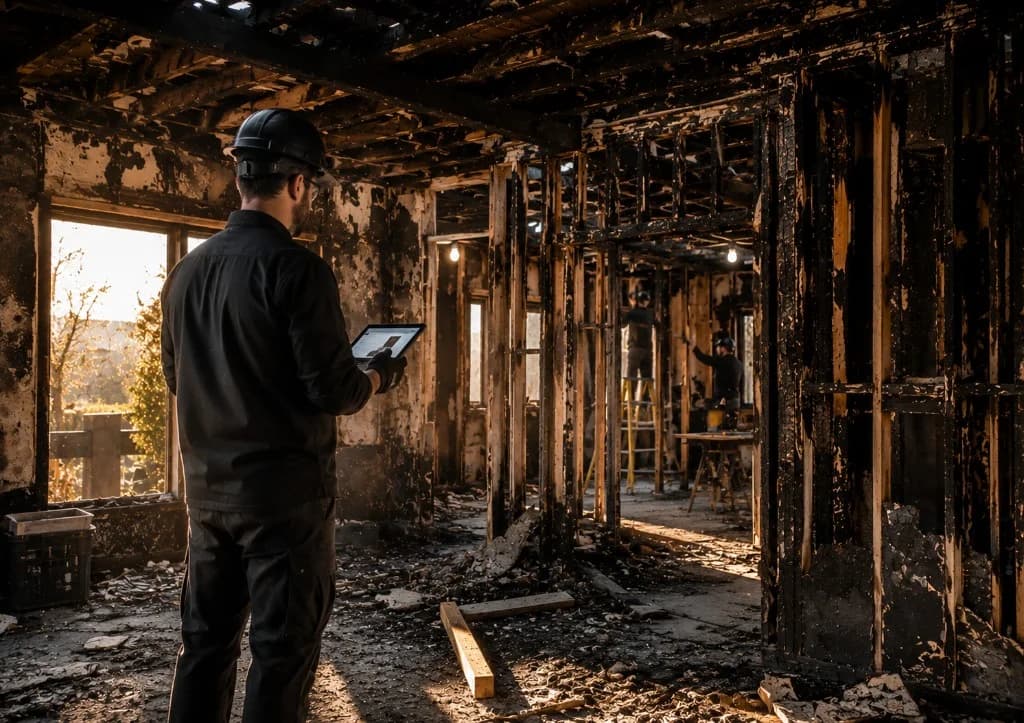
Fire claim support
Built for complex rebuilds, smoke losses, and multi-trade scopes
Fire claims rarely involve one clean scope. Claims Ninja helps contractors organize the structure, contents, mitigation, cleaning, code, and rebuild documentation needed to support the claim.
Structural Rebuilds
Support for demolition, framing, roofing, mechanical trades, finishes, and reconstruction scope alignment.
Smoke & Odor Losses
Documentation support for cleaning, sealing, deodorization, HVAC concerns, and affected material review.
Contents Coordination
Help aligning structure and personal property workflows when pack-out, cleaning, storage, or replacement are in play.
How it works
From fire file to claim strategy
- 01
Submit Claim Materials
Upload photos, estimates, mitigation records, engineering notes, contents documentation, carrier letters, and rebuild details.
- 02
We Build the Loss Picture
Our team reviews affected areas, fire and smoke damage, structural considerations, trade scopes, code items, and estimate gaps.
- 03
Supplement Opportunities Are Identified
We flag missing line items, pricing issues, scope gaps, documentation needs, and items that may warrant carrier review.
- 04
Contractor Gets a Clear Path Forward
You receive organized next steps, documentation direction, and claim support through a longer, more complex recovery cycle.
What we handle
Fire damage claim details carriers love to question
Structural Scope
Framing, roof systems, sheathing, drywall, insulation, and finish materials should align with damage conditions and rebuild requirements.
Smoke & Odor Treatment
Cleaning, sealing, deodorization, HVAC considerations, and affected porous materials may require detailed documentation.
Code & Ordinance Items
Electrical, mechanical, framing, fire separation, insulation, and jurisdiction-specific upgrades may require review.
Demolition & Debris
Tear-out, selective demolition, debris handling, access, protection, and labor conditions can materially affect the scope.
Contents & Pack-Out
Manipulation, inventory, cleaning, storage, disposal, and reset considerations may affect the claim depending on scope.
Multi-Trade Coordination
Fire losses often involve roofing, framing, electrical, HVAC, plumbing, drywall, flooring, paint, and specialty trades.
Common fire damage items that deserve a second look
Not every item is owed on every claim. These are common areas that may require review depending on documentation, policy, code, scope, and loss conditions.
- Smoke sealing and odor treatment
- HVAC cleaning or evaluation
- Electrical and mechanical scope
- Framing, sheathing, and structural repairs
- Insulation replacement
- Drywall, texture, and paint transitions
- Roofing and exterior components
- Contents manipulation or pack-out
- Debris removal and disposal
- Temporary protection and board-up
- Code-required upgrades
- Trade coordination and supervision
Frequently Asked Questions
Answers to common questions about fire damage claims.
Document site safety clearance, exterior and origin-room photos, smoke migration by room, structural components, HVAC status, suppression water damage, contents inventory, and demolition discovery — with room labels consistent across photos, sketch, and estimate. Indexed evidence supports supplements when scope exceeds the carrier estimate.
Carriers expect exterior elevations, origin room before mitigation, migration path through halls and upper floors, structural char and heat damage, HVAC registers and filters, water saturation from suppression, contents in place before pack-out, and demolition discovery during tear-out — all with room labels and dates in filenames.
Most property policies cover smoke and soot damage when documentation proves contamination beyond the fire origin — migration photos, test-clean results, and room-by-room scope. Carriers dispute localized versus systemic smoke; strong migration evidence and cleaning method notes support approval of smoke wipe, seal, and deodorization lines.
Fire supplement packages need indexed photos by room, migration path narrative, demolition discovery logs, HVAC and contents evidence, engineering or testing reports where used, and a cover letter mapping each attachment to estimate line items. This is the evidence inventory desk reviewers verify — phased supplements with contemporaneous capture outperform end-of-job narrative assembled after production closes access.
Document contamination by room with wide and close substrate photos, migration path narrative from origin through halls and upper floors, soot type notes, HVAC register and filter condition, odor logs, and test-clean results where clean-versus-replace is disputed — with room labels consistent across photos, sketch, and estimate. Indexed evidence supports supplements when smoke scope exceeds the carrier estimate.
Most property policies cover soot damage when documentation proves contamination beyond the fire origin — migration photos, substrate close-ups, test-clean results, and room-by-room scope. Carriers dispute localized versus systemic soot; strong migration evidence, soot type notes, and cleaning method documentation support approval of wipe, seal, and specialty cleaning lines.
Carriers expect wide room context plus close substrate photos showing soot color, texture, and extent on ceilings, walls, trim, and fixtures; migration path through halls, closets, and upper floors; HVAC registers and filters; cabinet interiors and cavities; test-clean before-and-after sets on disputed substrates; and attic or crawlspace access when migration is claimed — all with room labels and dates in filenames.
Replace when test-clean fails on the substrate, soot type prevents restoration (protein residue on porous materials, fuel-oil soot on unfinished wood), manufacturer guidance prohibits cleaning, or char and heat damage compromise the assembly. Document test-clean before-and-after photos, substrate condition, and manufacturer bulletins supporting replacement over clean-only carrier macros.
Smoke supplements need indexed photos by room, migration path narrative, test-clean results, HVAC and odor evidence, cavity and attic photos from demo discovery, and a cover letter mapping attachments to line items. Phased supplements with contemporaneous migration evidence outperform end-of-job narrative assembled after cleaning obscures conditions.
Document room-by-room inventories with description, quantity, pre-loss condition, and damage type before pack-out. Photograph high-value and questionable items in place, capture serial and model numbers on appliances and electronics, and maintain chain-of-custody logs for off-site storage. Room labels must match across photos, inventory, sketch, and estimate.
Carriers expect room-located inventories with item descriptions, quantities, condition notes, salvageability disposition, and photos for high-value items. Serial numbers, ownership documentation, and damage assessment notes support replacement lines. Pack-out and storage charges require inventory batch references and chain-of-custody logs.
Photograph soot coating, odor penetration, and contamination on textiles, furniture, and electronics before handling. Note smoke versus heat damage separately, document failed cleaning tests when replacement is claimed, and separate contents evidence folders from structural smoke documentation. Specialty evaluations support electronics, art, and textile lines.
Replace when heat damage, failed test-clean results, manufacturer guidance prohibiting restoration, or combined smoke-and-water exposure makes cleaning unreasonable. Document char, melt, or warping photos, specialty evaluation reports, and disposal justification before replacement lines. Carriers apply clean-only macros when disposition lacks supporting evidence.
Contents supplements need room-located inventories with in-place photos, chain-of-custody logs, specialty cleaning reports, storage duration records, and a cover letter mapping inventory rows to unpaid lines. Additional discovered items, extended storage, electronics testing, and high-value replacement require contemporaneous documentation — not end-of-job lump additions.
Document pre-pack-out room photos and inventory verification before first item movement. Maintain continuous chain-of-custody logs from site through transport, storage, and processing. Assign box and tote numbers tied to inventory batches, complete loading manifests and driver logs for each vehicle movement, and cross-reference every pack-out line to custody documentation before estimate submission.
Carriers expect unique item identifiers, barcode or label systems cross-referenced to inventory, box and tote numbering on loading manifests, vehicle and driver logs for each transfer, and customer or facility signatures at handoff points. Chain of custody must be continuous from first item movement through storage intake, processing, and return delivery — no undocumented gaps.
Log storage facility, vault or shelf assignment, intake date, and inventory batch reference at storage intake. Document environmental conditions for climate-sensitive items, periodic inspection logs when storage extends beyond initial estimate, and security measures when carriers question storage necessity. Tie every storage line to batch references and custody logs.
Pack-out charges require room-located inventories with batch references, loading manifests tying boxes to inventory rows, driver and transport logs, storage intake documentation, and estimate cross-references mapping each manipulation, transport, and storage line to custody logs. Billing without inventory substance and manifest proof fails contents desk review.
Document return delivery date, crew, vehicle manifest, and placement rooms with inventory batch cross-reference. Photograph reset placement for high-value items, obtain customer acknowledgement of return completion, and log any condition changes noted at delivery. Return delivery and repackaging lines require contemporaneous delivery logs — not end-of-job reconstruction.
Fire damage claims get underpaid when documentation cannot support billed scope: incomplete structural evidence, weak smoke migration proof, missing contents photos and serial numbers, pack-out chain-of-custody gaps, and supplement packages assembled after production closes access. Desk reviewers reduce lines they cannot forward internally — proportional underpayment follows when photos, inventories, and logs lack room labels and contemporaneous timestamps.
Carriers expect site safety clearance, exterior and origin-room photos, structural and demolition discovery evidence, smoke migration by room, HVAC status, suppression water damage, contents inventory with photos, pack-out chain of custody, and estimate narratives with room labels consistent across photos, sketch, and line items. Indexed evidence supports supplements when scope exceeds the carrier estimate.
Contractors support fire supplements by assigning a supplement owner, maintaining a gap log from intake, comparing carrier estimates within 48 hours, and submitting phased packages with cover letters that map contemporaneous evidence to line items. Field teams capture demolition, migration, HVAC, and pack-out proof during production — not after rebuild closes access — so resubmissions and reinspections have indexed exhibits ready.
Common delay triggers include unlabeled photos, inconsistent room names across sketch and inventory, missing pack-out chain of custody, HVAC scope without register photos, contents lists without in-place images, and supplement submissions without cover indexes. Carriers request additional information iteratively when files are not reviewer-ready — each round adds days before payment or partial approval.
Improve fire claim documentation by indexing files by room and phase from intake, using consistent labels on every photo and log, capturing migration paths and demolition discovery contemporaneously, maintaining pack-out chain of custody, and submitting supplements with attachment-to-line-item cover indexes. Compare carrier estimates early, train field leads on smoke and contents capture standards, and hold rebuild until high-risk documentation gaps close.
Effective files combine visual evidence, scope detail by room, cleaning method notes, and trade separation. Carriers scrutinize whether smoke damage is localized or systemic — documentation should match what your crew observed on site.
Yes. Our contractor resources library covers fire documentation, contents inventory standards, supplements, smoke and soot evidence, HVAC contamination, odor mitigation, and supplement denial recovery — organized for restoration and supplement teams.
Yes. Fire losses often span structure, contents pack-out, and deodorization. We organize scopes so carriers can review building and contents separately while keeping the overall claim narrative coherent.
Fire claims frequently evolve after demo reveals hidden damage. We track change orders and revised scopes so supplements reflect conditions discovered during tear-out — not just the initial adjuster walkthrough.
They can be. HEPA filtration, ozone or hydroxyl treatment, sealers, and content cleaning lines are often under-scoped on first carrier estimates. We evaluate whether your documentation supports pursuing those items.
Yes. From localized kitchen fires to major structural rebuilds, supplement strategy adapts to loss severity. Larger files benefit from organized trade breakdowns and phased documentation as work progresses.
Commercial fire claims require building- or suite-level indexing scaled to property footprint: documentation plan with folder index, building inventory, tenant coordination logs, separate structure and contents folders, engineering reports cross-referenced to estimate lines, and phased supplement submissions. Treat office, retail, industrial, and multi-tenant losses with indexed evidence per suite or zone — not residential single-file patterns.
Review lease type before attributing scope. Building owners typically cover shell, common areas, and base building systems; tenants cover interior build-out, trade fixtures, and business personal property under triple-net or standard commercial leases. Label every inventory entry, photo folder, and estimate line as shell, tenant improvement, or contents to prevent coverage disputes on both policies.
Higher insured values trigger specialist adjusters, engineering review, and third-party audit. Carriers reconcile structural, smoke, HVAC, contents, and general conditions scope against building-indexed photos and engineering reports — not residential estimate macros. Tenant coordination, business interruption overlap, and phased supplements add review layers single-dwelling files rarely face. Weak building-level evidence invites proportional reductions across the entire commercial file.
Mitigation contractors document contemporaneous operational facts: mitigation start and completion dates, zone release schedules, access restrictions, tenant displacement coordination, and phased production timelines. This supports insured BI narratives but does not replace coverage analysis or financial claim preparation. Share indexed timeline exports with the insured's BI preparer without preparing income projections or profit-and-loss valuations.
Frequent gaps: hidden structural damage discovered during demolition, smoke migration beyond origin zones, HVAC contamination after system inspection, code upgrades on commercial rebuild, temporary facilities during extended mitigation, commercial contents pack-out and storage, environmental abatement, general conditions under-scoped on large-loss files, and engineering revisions expanding MEP scope. Submit phased supplements with contemporaneous photos and indexed reports before covering new assemblies.
Fire code upgrades may be covered when ordinance and law endorsements apply and documentation proves the upgrade is required by the authority having jurisdiction — not contractor preference. Coverage depends on the individual policy, endorsement limits, and whether the carrier accepts permit records, inspection reports, and code citations tied to specific line items. Contractors document AHJ requirements and separate code scope from like-kind repair; carriers apply policy language. Outcomes vary by carrier and evidence quality.
Ordinance and law coverage is a policy endorsement that may pay for costs associated with building code compliance during repair or rebuild — commonly structured as Coverage A (undamaged portion demolition), Coverage B (increased cost of construction), and Coverage C (contingent liability) where listed. Availability, limits, and sublimits vary by carrier and policy. Contractors document code triggers and AHJ evidence; they do not interpret policy language or guarantee coverage outcomes.
Identify jurisdiction and adopted code edition early; obtain permit application and inspection records; assign one specific code citation or AHJ written requirement per upgrade line; capture tear-out photos showing prior non-compliant condition and install photos before close-in; separate code scope from like-kind repair in Xactimate; and write supplement narratives linking trigger, citation, photo reference, and quantity. Documentation wins code supplements — generic code lists trigger denials.
The authority having jurisdiction (AHJ) — typically the local building department, plan reviewer, or inspector — determines whether current code applies to repair or rebuild scope. Carriers evaluate whether documented requirements are tied to the loss and supported by permit and inspection evidence. Contractors research adopted code editions, submit permits, and log inspector communication; they do not unilaterally declare code requirements without AHJ or written code citation support.
Common denial reasons: generic code lists without job-specific application, no permit or inspection documentation, missing tear-out photos of prior non-compliant condition, code lines buried in undifferentiated repair macros, owner preference upgrades argued as code requirements, no ordinance and law coverage on policy, and late supplements assembled after production closes access. Resubmit with indexed permit records, AHJ correction notices, and one citation per line — outcomes vary by carrier and file specifics.
A complete fire damage supplement includes a cover letter with summary table, revised Xactimate estimate, indexed photo exhibits by room, migration path narrative, contents inventory pages, HVAC inspection evidence, demolition discovery photos, specialist report excerpts when used, and a correspondence log. Each requested line must map to at least one named exhibit.
Submit when documented scope exceeds the carrier estimate and contemporaneous evidence exists — within 48 hours on visible estimate gaps, after demolition discovery, when HVAC inspection returns, or when pack-out inventory is complete. Phased submission beats waiting for final invoice: migration, HVAC, and contents supplements approve more readily when evidence is captured before rebuild obscures conditions.
Fire supplement documentation includes indexed photos by room, migration path narrative, demolition discovery logs during tear-out, HVAC register and component photos, room-located contents inventories with pack-out chain of custody, engineering or IH report excerpts when used, and a cover letter mapping each attachment to estimate line numbers. Contemporaneous phased evidence outperforms end-of-job narrative assembled after production closes access.
Yes. Fire claims commonly require phased supplements — migration and emergency scope first, then HVAC and contents after inspection, then demolition discovery and code upgrades during rebuild. Label each supplement version in CRM with phase and date so carrier reviewers track discovery without treating later submissions as duplicate billing.
Commonly missed fire supplement items include smoke and soot cleaning in migration rooms, HVAC duct cleaning and component replacement, contents manipulation and pack-out, specialty soot cleaning procedures, odor mitigation equipment, selective demolition with pre-demo photos, temporary protection extensions, code-driven rebuild assemblies, and suppression water mitigation overlap documented separately from fire residue scope.
Contractors document smoke damage with room-by-room contamination photos, migration path narrative from origin through halls and upper floors, odor intensity logs, HVAC register and filter inspection, test-clean results for clean-versus-replace decisions, and concealed-area photos from attics and cavities — all with room labels matching sketch and estimate. Indexed folders by room and phase support supplements when smoke scope exceeds the carrier estimate.
Smoke damage claims need wide room context, mid-range vertical spread shots, and close substrate photos on ceilings, walls, trim, cabinets, and flooring in every affected room; migration path through halls and chases; HVAC registers, filters, and accessible duct runs; attic and crawlspace inspection when migration is claimed; test-clean before-and-after sets; and contents in-place photos — all labeled consistently with sketch room names and dated at intake.
Yes — when HVAC ran after the fire or when migration claims include duct pathways, carriers expect register and grille photos, filter condition at intake, accessible duct and plenum inspection, air handler interior photos when unit cleaning is billed, system type notes, and post-clean verification. HVAC scope without field evidence is among the first smoke lines reduced on desk review.
Smoke claims get underpaid when documentation treats contamination as cosmetic, omits odor mapping and HVAC evidence, skips concealed areas, delivers unlabeled photo rolls, fails to separate cleaning from replacement, and lacks written migration narrative. Carriers approve scope they can match to sketch rooms — incomplete smoke files produce proportional reductions rather than full denial.
Yes. Smoke damage includes vapor-phase deposition, odor absorption in porous materials, particulate in wall cavities, and microscopic soot in HVAC media — often without obvious surface staining. Protein fires and slow-burn losses frequently produce persistent odor with minimal visible residue. Document odor logs, cavity inspection, test-clean results, and HVAC filter condition to prove impact carriers cannot see in wide photos alone.
Include a cover letter with attachment index, revised Xactimate estimate, room-labeled photo exhibits, smoke migration narrative, demolition discovery log, HVAC inspection evidence, contents inventory pages, pack-out chain-of-custody records, code citations with permit support, specialty report excerpts when used, and a correspondence log. Each requested line must map to at least one named exhibit before submission.
Plan a minimum structured set per affected room: at least one wide shot, one mid-range ceiling-and-wall shot, and substrate close-ups for each billed surface — plus migration progression, exterior elevations, HVAC registers, demolition discovery, and contents in-place images. Complex fire files often exceed 200–400 labeled photos; volume matters less than complete room coverage and consistent labels across photos, sketch, and estimate.
Smoke damage documentation includes migration path photos from origin through connected spaces, room-by-room odor intake logs, substrate close-ups with soot type notes, test-clean results where clean-versus-replace is disputed, HVAC register and filter condition, and cleaning method rationale tied to contamination type. Indexed evidence supports supplement lines when smoke scope exceeds the carrier estimate.
Carriers request additional documentation when files are not reviewer-ready — unlabeled photos, inconsistent room names across sketch and inventory, missing pack-out chain of custody, HVAC scope without register evidence, contents lists without in-place images, or supplement packages without attachment-to-line-item indexes. Each request for information adds days before payment; complete pre-submission documentation prevents iterative RFIs and proportional reductions on unsupported lines.
Fire damage supplements are denied when documentation does not support billed scope — incomplete room photos, weak smoke and soot evidence, undocumented hidden damage, missing contents inventories, pack-out chain-of-custody gaps, unsupported code upgrades, disorganized estimates, or absent narratives. Desk reviewers approve scope they can verify; unverifiable lines get denied or reduced proportionally even when field work was legitimate.
Yes. Missing documentation is the leading cause of fire supplement denials and proportional reductions. Unlabeled photos, rooms without ceiling shots, absent migration narratives, incomplete HVAC evidence, contents lists without in-place images, and supplement packages without attachment-to-line-item indexes each give desk reviewers reason to deny unsupported scope — even when coverage exists for the damage type.
Review the stated denial reasons line by line, identify the documentation gap for each denied item, and resubmit with targeted evidence — revised estimate, room-labeled photo index, smoke and soot support, HVAC attachments, contents inventories, and cover letter mapping exhibits to line numbers. Address every carrier question with named exhibits rather than resubmitting the same package. The fire damage supplement denial recovery guide covers resubmission workflow.
Yes. Resubmission amends the same loss — it is not a new claim. Submit additional photos, discovery logs, HVAC reports, contents inventories, code citations, and revised estimate narratives addressing each stated denial reason. New evidence captured after repairs close access carries less weight than contemporaneous documentation; phased supplements submitted during investigation recover more scope than backfilled resubmissions.
Incomplete photo documentation is the most common preventable failure — missing rooms, absent ceiling and migration shots, unlabeled image dumps, and photo sets that do not match sketch and estimate room names. Weak smoke documentation and undocumented hidden damage during demolition are close second and third causes. Most failures are documentation problems, not coverage disputes — preventable with pre-submission checklists and repeatable workflow.
Ready when you are
Start with a free claim review
Tell us about your operation. We'll assess your claim workflow, identify recovery opportunities, and outline next steps.