Solutions
Roofing Claims
Maximize recoveries on residential and commercial roofing losses with documentation, supplement strategy, and carrier negotiation built for real roofing operations.
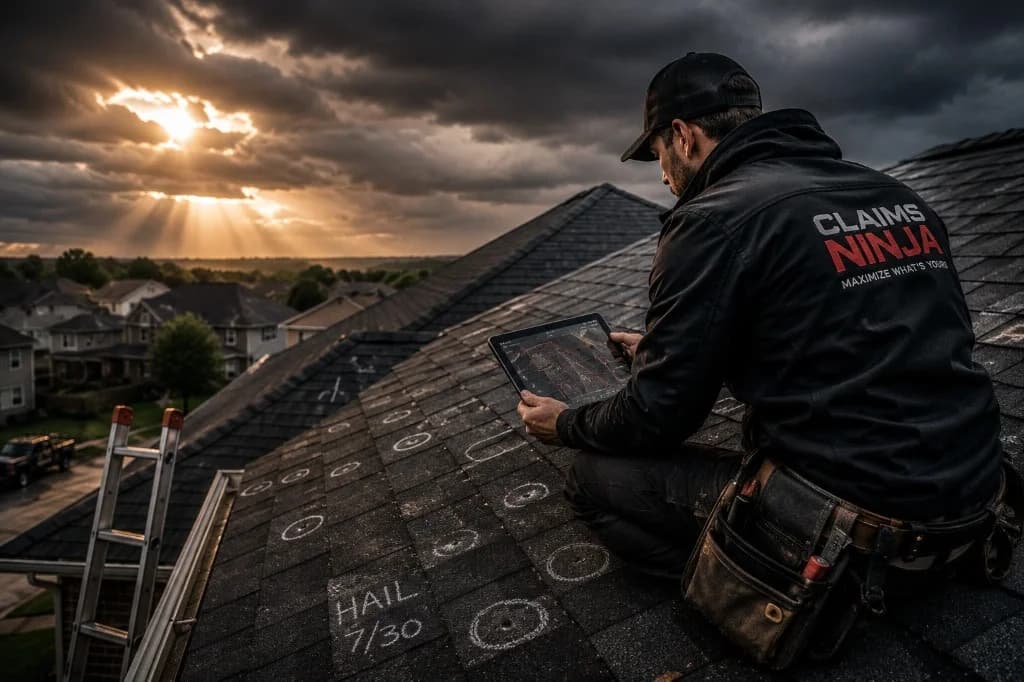
Roofing claim support
Built for storm volume, retail roofing, and complex carrier scopes
Roofing claims move fast. Claims Ninja helps contractors turn photos, estimates, measurements, code requirements, and field documentation into organized supplement opportunities.
Storm Restoration
Support for high-volume storm books, repeat claim intake, and documentation consistency across multiple roof losses.
Residential Roofing
Supplement strategy for shingles, accessories, ventilation, code items, waste, steep charges, and carrier scope gaps.
Commercial Roofing
Support for flat roofing, coatings, membranes, metal systems, larger scopes, and documentation-heavy carrier review.
How it works
From roof documentation to supplement strategy
- 01
Submit Claim Materials
Photos, estimates, EagleView/measurements, scopes, carrier letters, and job details come into one organized review process.
- 02
We Build the Claim Picture
Our team reviews quantities, roof components, damage documentation, code considerations, and estimate gaps.
- 03
Supplement Opportunities Are Identified
We flag missing line items, pricing issues, scope gaps, and items worth pursuing with the carrier.
- 04
Contractor Gets a Clear Path Forward
You receive organized next steps, documentation direction, and claim support without building an internal claims department.
What we handle
Roofing claim details carriers love to miss
Scope Accuracy
Line-item detail aligned to manufacturer specs, damage patterns, roof system components, and how the roof was actually built.
Code & Compliance Items
Items such as drip edge, ice and water shield, ventilation, decking requirements, and jurisdiction-specific upgrades may require review.
Waste & Measurement Factors
Roof geometry, waste factors, pitch, layers, cut-up complexity, and measurement discrepancies can materially affect the final scope.
Flashing & Penetrations
Step flashing, counter flashing, pipe boots, vents, valleys, skylights, and wall intersections often deserve a closer look.
Steep, High & Access Charges
Pitch, height, access limitations, safety requirements, and labor conditions may create legitimate scope considerations.
Roofing Accessories
Starter course, ridge cap, hip cap, vents, drip edge, valley components, and other accessories can be missed or under-scoped.
Common roofing items that deserve a second look
These line items are commonly missed depending on scope, code, and documentation. Each may require review—not every item is owed on every claim.
- Drip edge and starter course
- Ice & water shield
- Valley metal or valley lining
- Ridge cap and hip cap
- Step flashing and counter flashing
- Pipe boots, vents, and accessories
- Steep and high charges
- Tear-off, waste, and labor factors
- Code-required upgrades
- O&P or supervision where applicable
Frequently Asked Questions
Answers to common questions about roofing claims.
Carriers expect photos of all slopes and damage, accurate measurements, line items aligned to how the roof was built, and code-related accessories where applicable. Supplement opportunities often hinge on drip edge, ice and water shield, ventilation, steep charges, and waste factors documented clearly.
Yes. Storm books need consistency across high volume; retail jobs need precision on scope and code items. We adapt documentation and supplement strategy to how your roofing operation actually runs — residential, commercial, or both.
We review jurisdiction requirements, manufacturer specs, and field conditions to identify code-driven line items carriers often omit. Items like drip edge, starter course, ice barrier, and ventilation are evaluated based on what the job requires — not automatically added to every file.
Yes. Commercial roofing often involves membranes, coatings, metal systems, and larger scopes with heavier documentation requirements. We organize complex estimates and trade coordination so carrier review stays manageable.
Accurate measurements anchor defensible quantity arguments. Waste, pitch, and cut-up factors should reflect actual roof geometry — not generic defaults. We compare carrier quantities to field documentation and flag gaps worth pursuing.
O&P depends on carrier guidelines, number of trades, and how the claim is structured. We evaluate whether O&P applies to your file and document the basis when pursuing it — outcomes vary by carrier and claim circumstances.
Supplement support includes scope review, line-item analysis, documentation guidance, and carrier-ready supplement submissions. Expert teams identify missing items, pricing gaps, and code-related opportunities — then organize the file so adjusters can review efficiently.
Roof matching refers to whether replacement materials reasonably align with existing roofing in color, profile, texture, and visible appearance when a carrier approves partial repair. Disputes arise when discontinued shingles, weathered materials, or partial slope replacement leave visible differences across roof planes. Matching concerns are evaluated against field documentation, material availability, and policy language — outcomes vary by carrier and claim circumstances.
Identify the existing shingle type, manufacturer, color, style, and age; capture wide elevation and slope-by-slope photos; research material availability with dated supplier or manufacturer confirmation; document repairability concerns on brittle or fragile existing material; and build a scope comparison table tying carrier repair boundaries to field conditions. A one-page contractor narrative should link each requested scope line to specific evidence — not legal arguments or guaranteed outcomes.
Wide roof elevations from primary viewing angles, slope-by-slope photos with consistent labeling, close-up material photos for identification, side-by-side comparisons of sample shingles against existing courses in consistent lighting, and photos of transitions between the approved repair area and adjacent slopes. Damage-only close-ups without elevation context rarely support matching scope arguments at desk review.
Common denial reasons include insufficient material identification, no availability research confirming discontinued or unavailable products, weak photo evidence without elevation context, cosmetic-only damage arguments, policy language limiting matching scope, and scope requests not tied to documented field conditions. Carriers also deny when repairability concerns are asserted without photos or when partial repair is deemed sufficient based on the evidence provided — outcomes vary by carrier program and file specifics.
Discontinued or unavailable shingles can support a matching supplement when documentation confirms the exact product is no longer available and comparable replacements differ in color, profile, or dimensions. Save dated manufacturer discontinuation notices, distributor availability checks, and photos showing visible differences between existing material and available alternatives. Documentation should tie availability research to specific scope lines — approval is not guaranteed and depends on carrier policy and evidence quality.
Roof repairability describes whether existing roofing material can be partially removed, lifted, or replaced without causing additional damage to adjacent courses or compromising the roof system. It depends on documented field conditions such as material age, brittleness, seal strip adhesion, manufacturer guidance, and collateral damage risk during repair. Repairability is separate from matching — it addresses physical feasibility, not whether replacement materials align with existing appearance. Outcomes vary by carrier, policy, and evidence quality.
Capture roof overview and close-up material photos; perform and document repairability testing with field notes on brittle observations, seal strip adhesion, and removal behavior; photograph collateral damage such as broken tabs, torn shingles, and nail pull-through; review manufacturer repair recommendations; and build a scope comparison table tying carrier-approved repair areas to field conditions. A one-page contractor narrative should link each repair limitation to specific evidence — not legal arguments or guaranteed outcomes.
A brittle test evaluates how existing shingles respond when lifted or disturbed during a proposed repair. Contractors typically select a representative test area within or adjacent to the approved repair boundary and observe whether tabs crack, break, fail to reseal, or cause collateral damage to adjacent courses. Results should be documented with dated field notes and photographs of before, during, and after observations. Testing approaches vary by contractor and carrier program — the goal is objective documentation of material behavior, not adherence to one mandatory method.
A complete repairability package includes roof overview photos, close-up material condition shots, test square documentation with brittle observations, collateral damage photos, manufacturer identification and repair guidance, dated field notes, a contractor narrative, and a scope comparison linking evidence to estimate lines. Each repair limitation should reference specific photos or test results — unsupported conclusions rarely survive desk review.
Carriers commonly dispute repairability when documentation lacks test observations, photos do not show collateral damage, material identification is missing, narratives assert brittleness without field evidence, or scope requests are not tied to documented repair limitations at the approved boundary. Adjusters may also argue partial repair is sufficient based on their own field assessment or policy language. Strong documentation with dated test results, indexed photos, and scope comparison tables improves communication during review — approval is not guaranteed.
Request a roof reinspection when the carrier estimate does not reflect documented field conditions — missed storm damage, additional affected slopes, matching or repairability concerns, code upgrade omissions, or scope gaps identified after the initial inspection. Build the complete documentation package before requesting the visit, not after scheduling. Reinspection is most effective when photos, scope comparison, and narrative are indexed and ready for adjuster review — outcomes vary by carrier and evidence quality.
Assemble roof overview and slope-by-slope photos, close-up damage shots, soft metal documentation, material identification, matching and repairability records when applicable, a carrier estimate comparison table, a contractor narrative summary, and supplement support notes indexed to estimate lines. Complete the packet before requesting reinspection so the adjuster arrives with context — not legal arguments or guaranteed outcomes.
Yes — contractors can document additional hail, wind, or impact damage discovered after the carrier's initial visit using dated slope-labeled photos, close-up damage shots, measurement data, and a scope comparison showing what was omitted from the carrier estimate. Documentation should be captured as soon as damage is identified and organized before requesting reinspection. Carriers evaluate post-inspection documentation against evidence quality and timing — approval is not guaranteed.
Common denial reasons include incomplete documentation packages, unlabeled or disorganized photos, scope requests not tied to field evidence, unsupported matching or repairability claims, reinspection requested before building the indexed packet, or carrier determination that desk review is sufficient from existing photos. Carriers may also deny when damage appears cosmetic-only or when policy language limits the requested scope — outcomes vary by carrier program and file specifics.
Label every photo with slope name, elevation, and date in file metadata. Capture wide overview shots of each plane before close-up damage detail. Pair every close-up with a context photo showing location on the slope. Group photos by slope and damage type in the claim file index. Tie each photo reference to a specific line in the scope comparison table and contractor narrative — organized, objective documentation supports accurate claim review.
Hail documentation focuses on circular impacts, mat fracture, test square or impact survey results, and soft metal collateral dents on vents and flashings. Wind documentation focuses on creased tabs, lifted shingles, broken seal strips, ridge and starter displacement, and directional damage patterns on windward slopes. When both perils apply on the same file, document each mechanism in separate photo groups indexed to the same scope comparison — blending evidence weakens attribution at desk review.
Photograph each layer progressively as tear-off proceeds — not in a single post-removal summary shot. Label each photo with slope name, date, layer count, and material type of the exposed course. Tie additional tear-off layer charges to the progressive photo sequence and field notes in the supplement narrative. Carriers deny layer discovery reported after tear-off when pre-removal and mid-removal evidence is missing.
Flashing qualifies for replacement when storm damage bends, creases, or displaces metal beyond patch repair — step flashing pulled from walls, cracked pipe boots, bent drip edge, or valley metal with impact or wind deformation documented in close-up and context photos. Patch-only scope is harder to defend when photos show structural deformation, failed seal, or multiple damaged segments on the same elevation. Index each flashing photo to a specific supplement line item and slope label.
Commercial roof damage documentation starts with a labeled roof plan and zone-indexed photos — overview and close-up pairs for membrane field damage, seams, flashings, coping, edge metal, drains, scuppers, and penetrations. Document the assembly type (TPO, EPDM, PVC, mod bit, BUR, metal, SPF, or coating), perform moisture surveys and core sampling when wet insulation is suspected, and correlate interior ceiling maps to roof zones. Reconcile measurements to the carrier sketch, attach manufacturer specs, and index every photo to estimate lines before supplement submission.
Commercial roofing supplements require a scope comparison table linking carrier estimate lines to zone-indexed field evidence: roof plan, progressive tear-off photos, moisture survey maps, core sample results, equipment detach-reset inventory, and interior water migration maps. Include manufacturer guidance when disputing patch-only scope, code citations for upgrades, crane and staging photos for access constraints, and a contractor narrative indexed to each disputed line. Run the Roofing Supplement Checklist before submission — incomplete moisture proof and missing equipment documentation are the most common commercial supplement denials.
Many carriers approve moisture survey and core sampling costs on commercial roofing claims when results justify wet insulation replacement — but payment depends on contemporaneous documentation linking scan results to specific roof zones and estimate lines. Perform surveys before tear-off when interior leaks, ponding, or storm openings suggest wet substrate. Document authorization requests, technician reports, and mapped readings indexed to the roof plan. Unsupported wet insulation claims without moisture proof are commonly excluded even when insulation replacement scope is otherwise defensible.
Photograph roof overview from each corner and zone, then close-ups of membrane field damage, seams, flashings, coping, edge metal, expansion joints, drains, scuppers, HVAC curbs, skylights, and roof-mounted equipment. Capture drone and ground context when permitted. Document test squares or impact areas, moisture survey grids, core sample locations, interior ceiling conditions, and temporary emergency repairs. Every close-up needs an overview pair with zone label, date, and direction — desk reviewers cannot approve scope they cannot locate on the roof plan.
Full commercial system replacement requires evidence beyond surface membrane damage: moisture survey and core sample proof of wet insulation, manufacturer specs showing damage exceeds patch limits, repairability analysis when aged membrane cannot be resealed, matching documentation when product is discontinued, code upgrade citations, and photos of multiple impact areas or failed seams across sections. Document tear-off layer count, deck condition, cover board requirements, and equipment detach-reset scope. Cross-reference the Roof Repairability and Roof Matching Documentation Guides when carriers approve partial scope on low-slope assemblies.
Roof damage responsibility in an HOA depends on governing documents — CC&Rs and bylaws define which roofs, elevations, and accessories are common elements maintained by the association versus unit-owner responsibilities. Contractors should document the management-provided responsibility summary, photograph association-owned areas separately from unit-owner boundaries, and index scope lines to the correct insured party. When boundaries are disputed, contemporaneous board and property management communications strengthen attribution at carrier review — not legal interpretation by the contractor.
HOA master insurance policies typically cover common-element roofs declared in the association's coverage, but payment depends on policy terms, deductibles, damage cause, and governing document allocation — not automatic full-community replacement. Contractors should document the master policy claim number, deductible handling per management guidance, and building-specific damage that supports replacement scope on affected structures. Board authorization records and building-level photo evidence strengthen approval when carriers question scope extent on partial-building losses.
HOA roof damage documentation starts with a building inventory and community site plan — every structure numbered consistently across photos, measurements, and estimates. Photograph every elevation on every building with overview and close-up pairs; index shared components (gutters, carports, clubhouses) separately. Attach governing document responsibility summaries, access coordination logs, and board communication records alongside field evidence. Per-building scope comparison tables tied to photo indexes are essential before supplement submission on community association files.
Full-community replacement when only some buildings are damaged depends on matching requirements, governing document standards, manufacturer repair limits, and functional damage attribution — not automatic approval. Document elevation comparisons showing color and profile mismatch between damaged and undamaged buildings, repairability analysis per structure, and governing document uniformity requirements cited by management. Carriers often approve full replacement on affected buildings while denying undamaged structures — building-level photo evidence and matching documentation support partial-community scope arguments.
HOA roofing supplements require building-indexed scope comparison tables linking carrier estimate lines to per-building photo evidence, measurements, and governing doc context. Include mobilization logs for multi-building deployments, access delay records, board authorization documentation, and progressive tear-off photos for hidden damage discoveries. Run the Roofing Supplement Checklist before submission — missing building-level indexing and undocumented access delays are the most common HOA supplement denials.
Carriers treat multi-building roof claims with higher scrutiny: specialist adjusters, engineer review, representative sampling on subsets of buildings, and aggregated scope tables that may omit building-level detail. Desk reviewers expect site maps, building inventories, per-structure photo indexes, and measurement reconciliation — not single-folder residential documentation. Document every building with identical standards so sampling disputes cannot exclude undamaged-looking structures with identical field conditions.
Carriers often approve replacement only on buildings with documented storm damage, but contractors may support broader scope when matching, repairability, manufacturer patch limits, or uniform appearance arguments apply across campus sightlines. Document elevation comparisons, supplier discontinued notices, and repairability test results per building — not only on carrier-selected samples. Partial replacement disputes on apartment complexes, office parks, and hotel campuses follow the same building-indexed evidence standards as single-structure matching claims.
Apartment complex roof documentation starts with a building inventory and labeled site map — every structure numbered consistently with property management records. Photograph overview and close-up pairs for every elevation on every building in separate indexed folders. Perform test squares per building on hail losses, correlate interior top-floor stains to roof zones, and log tenant access coordination contemporaneously. Reconcile measurements per building to the carrier sketch and tie every estimate line to building-specific photo evidence before supplement submission.
Matching across multiple buildings requires elevation photos showing color, profile, and weathering differences between replaced and unreplaced structures; supplier letters confirming discontinued materials; and campus sightline comparisons showing visible mismatch from common areas. Document identical roof systems and ages across buildings to support uniform appearance arguments. When only damaged buildings are replaced, photograph the contrast from ground level and adjacent buildings — not only close-ups on the repaired structure.
Large multi-building roofing supplements require building-indexed scope comparison tables linking carrier estimate lines to per-building photo evidence, measurements, and mobilization logs. Include crane setup photos, material staging constraints, phased production schedules, progressive tear-off photos for hidden damage, and access delay records across occupied campuses. Run the Roofing Supplement Checklist before submission — missing building-level indexing and undocumented mobilizations are the most common multi-building supplement denials.
Ready when you are
Start with a free claim review
Tell us about your operation. We'll assess your claim workflow, identify recovery opportunities, and outline next steps.